Madison County Real Estate and Community News

April 19, 2021

Who You Work With Matters: Top 5 Concerns About Real Estate Agents

An industry that is millions of real estate agents strong comes with its own set of compliments and complaints! In fact, as of October 2020, there were 1,451,031 members of the National Association of Realtors. Buying or selling a home is the biggest financial transaction that you'll have in your life, so of course, who you work with during that transaction matters. Just like with any job, there are expectations placed upon real estate agents, but when they are not met, they may leave you with a sour taste in your mouth.

Our goal is always to be transparent, so you'll find the top five concerns that folks may have about real estate agents so that you can ensure you hire the right agent to help you. Your experience should be as stress-free and smooth as possible, and that is what we strive to achieve. 

Lack of Communication

It’s safe to say that one of the biggest complaints about real estate agents is a lack of communication. Of course, just like in any relationship, good communication is the most important component for success. On the flip side, if it lacks, it can ignite a chain reaction of unpleasant and awkward experiences for the client that ultimately lead to an unsuccessful partnership. 

Full-time agents often get calls, texts, and emails at all hours of the day, and for some, it can be difficult to manage. A skilled agent knows how to juggle communication and their other commitments and make each client feel like they are their only one. Communication expectations should be realistic and set up front to maintain a successful relationship. Answering questions promptly won’t necessarily help the home sell faster but keeping the client in the loop is always necessary and, in turn, increases their confidence in choosing the right agent.    

Of course, agents don't intend to fail or fall short of expectations. Many agents start responsive and with the best intentions when signing the listing agreement and the first few weeks of activity and showings. But once showings and interest start to taper off, the agent may feel that they have nothing to report to the client. They say no news is good news, but that couldn’t be further from the truth in this aspect. When there’s no news to report, the last thing the agent should be doing is not returning calls (i.e., ghosting). This is an opportunity to be transparent and show the client what they are doing behind the scenes to sell their home and restrategize if necessary. There is no excuse to drop the ball on communication at any point in the journey but especially not in the middle when the client has the most questions and concerns.

Lack of Real Estate or Area Knowledge

One of the most important things that your real estate agent should not lack is knowledge of the market area. This can become a major pain point when it comes to pricing a home properly. You want to work with someone who is an area expert. If the agent does not use their area expertise, understanding of the current market, and comparable sales near you, but instead gives the sellers a price that will make them happy just to attract business can lead to a domino effect. Overpricing your home can increase your chances of not finding a buyer or staying on the market longer than necessary. 

Your agent should also be a wealth of real estate knowledge. When it comes to going through the paperwork and legal documents, your agent should be able to explain most of the terms and language you may encounter. They should be able to guide you through the tough parts of the transaction with confidence and excellence. An agent that seems confused when explaining transaction details or cannot tell the seller what documents or contracts contain will naturally make the sellers feel uncomfortable.

Doesn’t Have the Client’s Best Interest at Heart

While we know every real estate relationship starts with the best intentions, there are times when a buyer or seller can feel their agent isn’t keeping the client in mind throughout the process. This feeling can fester for a multitude of reasons. Sometimes, clients and their agents don't align for one reason or another throughout their communication and interaction. Then, the client can sense their wants and needs are not being thoroughly listened to. The perception can be that the agent is more interested in serving their own interests, such as timeframe or a commission check after closing. It is, unfortunately, a bit too common to hear that a representative has been hasty in evaluating or coaching a client to sell or buy even when they were not completely ready. Instead of carefully and considerately waiting to find the right opportunity, they attempted to push their client into something they were not sold on.

In any real estate transaction, your agent must always thoughtfully listen and adapt to your desires and concerns at all times. No matter how long it takes to find the right buyer for your house or for, you to fall in love with your next home, your experience matters. An agent obsessed with creating joy for their clients will always have a bit of their heart in the game. 

Doesn’t Take Marketing Seriously

Many sellers are concerned that their agent will simply “post and hope,” meaning the agent will list your home on the MLS and sit back, hoping for potential buyers to reach out. A talented agent will not just post and hope. They will actively market your home. Your agent should use marketing channels best fit for your property, including social media, email campaigns, open houses, and more. Some agents may hire a marketing firm to expand their efforts to raise awareness about your house as well. Remember, you hired your agent to attract as many potential buyers as possible, so a smart agent will hire help where they know they will need it.

You can ask your agent about their marketing plan for your home, and they will explain why they chose some channels over others. Your real estate agent will know how to best market your property based on its location, price, and top features. 

Lack of Professionalism

Finally, your agent should be professional and treat not only you but all of the other parties involved in the transaction with respect. Here are the signs of an unprofessional agent:

They Have Few Testimonials. When interviewing your future agent, you will want to chat about their past transactions and experiences working with clients. They should recall specific details of their previous deals and have testimonials for you to reference. Not being able to discuss their past success is a sign that they haven’t had much. 

They're Profit Focused. If your agent is only focused on what they are getting out of working with you (and portraying that to you), they are definitely unprofessional. Your agent should be focused on your needs to ensure a successful transaction. 

The Part-Time Agent. This agent will make it known that this is merely a second job to them. They tend to seem split between two places at once. This can cause mix-ups that you don’t want to happen when going through something as important as a real estate transaction. You want someone who is completely dedicated to the profession and you.

They're Late or Don't Show Up. This is by far the most obvious way an agent can display unprofessionalism. By either being late or not showing up to a showing, they aren't displaying respect or professionalism.
Posted in Real Estate News
April 6, 2021

10 Creative Ways to Get Your Offer Accepted

Over the past year, the real estate market has been so hot that it’s not unusual for homes to go off-market in days. (The lack of inventory is to blame.) When even homes that need serious work are breaking price records, it is easy to feel discouraged if you’re trying to buy right now.

Don’t give up, though. Getting your offer accepted isn’t necessarily about coming in with the biggest bag of money. It’s really being able to anticipate what, exactly, the seller’s goals are and creating the offer that solves all of their problems. While your agent will weigh in with a strategy based on your market, there are a few common ways you can make your offer stand out. Whether you’re dealing with competition from investors or want to be sure you are making the best impression as a potential buyer, here are a few things that’ll increase your chances of a successful offer.

Hire an agent with connections

A large part of getting an offer accepted is the communication between your real estate agent and the seller's real estate agent. If your agent has connections or can communicate effectively, the deal is more likely to move forward. Your agent should be asking the seller's real estate agent what their client needs to get out of this deal. Is it the most money possible? Is it a specific timeframe, or do they need to rent the property back while searching for a new home? Knowing those needs and submitting an offer that meets them is vital.

Get in early

Staying in touch with your real estate agent pays off big. They’ll let you know as soon as homes enter the market, especially if they have many connections to other agents. Sometimes, agents will hear directly from other agents about a home that’s about to get listed — or that won’t enter the MLS at all (this is typically called a “pocket listing”). Regardless of how your real estate agent finds the home that fits your needs, be the first to book a showing and get ready to make an offer on the spot.

Be prepared to go over asking

In a seller’s market, it’s rare to find a bargain. While there are scenarios where you may end up successfully offering under-asking price (local market trends will inform our strategy), expect to offer a little more for the home you really love.

Offer earnest money

Earnest money is a cutely-named deposit made to the seller and held in escrow. It’s made after the seller accepts your offer and shows that you’re serious about buying. It’s not “extra” money because it’ll eventually be applied towards your deposit and/or closing costs. The typical amount is 1-3% of the purchase price and due within a few days of the seller accepting your offer, so make sure this money will be ready if you’re offering it.

Write a letter to the sellers

When you make your offer, enclose a handwritten letter to the owners thanking them for their time in considering your bid. But don’t stop at a simple thank-you. This letter is about building a personal connection that normally isn’t made when sellers just look at a bunch of numbers. Expand on why you love the home and what caught your eye. If there’s a feature that sparked your interest, it’s an opportunity to build a personal connection. For example, a lovingly-tended garden or a kitchen with all the bells and whistles that a home cook would love. Above all, be honest and genuine.

Be flexible

If you’re open to the seller choosing the closing date, you may just get an edge over other offers, especially if the home just went on the market. Think of it this way: Sellers are also usually trying to find another home while selling theirs and may need more time. If the seller is in this boat, the idea of having extra time may be worth more than the extra money another buyer is offering.

Nix the contingencies — when it makes sense to do so

A contingency is something that makes your offer conditional based on something happening. The three most common contingencies in a buyer’s offer are loan, inspection, and appraisal. Making an offer contingent on getting a loan, an inspection with minimal issues, or appraising for the amount you’re offering, presents multiple opportunities for the transaction to fall through. If you’ve been preapproved for a loan, the seller has had the property inspected by a reputable company, and you’re confident that the property wouldn’t appraise at a lower value, discuss with your agent whether or not you need these contingencies.

Beat out investor interest with a strategic offer

If you’re in an area that’s caught the attention of investors and flippers, don’t lose hope. Winning out over these types of offers is a matter of thinking of the downsides of accepting investor offers. For one, investors tend to offer all-cash but make lower offers because they’re offering cash. Second, they often want the property ASAP, forcing the seller to consider a quicker timeframe than they’d like. You can potentially beat investor offers by making an offer at the asking price (or slightly higher) and emphasizing flexibility on time frame.

Consider an escalation clause

An escalation clause in your offer means you’ll increase your offer to a certain price if another offer comes in. (It’s kind of similar to how, in an online auction, you can set a price limit, and bids will be entered automatically until that point.) This can be a risky thing — the seller may just counteroffer your price maximum or raise the asking price entirely. For properties that have multiple offers on the table, this may be something to consider.

Make sure you have your ducks in a row

Ensuring that you have your paperwork sorted, earnest money put away, your downpayment funds ready to go, and your real estate agent ready to write an offer as soon as you find "the one" will make the entire process go as smoothly as possible.

The first types of offers that sellers will likely reject are ones from only pre-qualified buyers for a mortgage. Pre-qualification means that a mortgage company has really just taken a glance at your financials to give you a rough estimate on what the amount and interest rate would be. (Often, pre-qualification doesn’t even involve a credit check.) In a seller’s eyes, this means that a lot of things could sink the transaction. 

Instead, get a pre-approval. This is a more rigorous process that will look at your credit report, verify pay stubs, bank statements, and other financial documents. If you pass their underwriting requirements, the lender will give you the actual numbers for the loan you’ll be able to get once you find a home (and then provide you with a letter to provide as proof).

If you’re very serious about getting your dream home, you may be able to get a pre-underwriting letter. This is a more thorough process that includes a thorough examination of financials and other documentation needed for a mortgage.  

BONUS

Don’t ask for anything

Even if there’s a gorgeous chandelier you’ve spent years searching for, keep it out of your offer. The key to getting your offer accepted in a heated market is to present the easiest, stress-free scenario for a seller. While they may be open to including particular items in the sale, making requests may give the impression that there will be a lot of back-and-forth with the transaction.

March 29, 2021

Buying or Selling Your Madison County Home By the End of 2021? Here’s What You Should Do Now

Here’s the month-by-month breakdown of what you can expect if you’re buying or selling by the end of the year. 

Whether 2020 put off your plans to sell your home or enter the market as a buyer, or you were aiming to do either this year already, 2021 is shaping up to be a great year to make your move(s). For sellers, there are plenty of interested buyers out there — in fact, more buyers than there are available properties in many markets. Buyers, don’t let that put you off of making the leap to homeownership. Sellers are seeing the steady demand and becoming more eager to list their homes.

Of course, achieving your goal doesn’t happen overnight. If you’re realistically looking at buying or selling in 6-9 months (the most common timeframes for buyers and sellers), here’s how you can best break up the months ahead with minimal stress.

Month 1-2: Making Goals & Going Over Numbers

If you’re buying: One of the biggest mistakes potential buyers make is focusing on the type of home they want instead of its location. Yet, location determines everything from how much house you can afford to the length of your commute to your lifestyle. While you can always change a home, you can’t change its location. So, narrow down the locations you’d like to live in. If you’re still having trouble deciding, make a list of what you’d like in your ideal neighborhood (or your deal-breakers) and let it guide your research. 

Your other priority will be developing your financial picture, so to speak. What are your debts? What are your assets? What’s your income-to-debt ratio? Where will the down payment come from? Ultimately, what would you like your monthly mortgage payment to be?

If you’re selling: Many sellers think that once they make up their mind to sell, they can call up a real estate agent and have them handle everything. However, an agent can best help you meet your goals when you’re prepared to answer what those goals actually are. Is your goal to get the highest price for your home — and you’re willing to make possible changes that may be needed to achieve that? Are you comfortable with your agent hiring a stager, or do you prefer to be heavily involved with the staging process? Or, would you prefer to focus your attention on your upcoming move rather and do not want to get too involved in making changes? Do you have a timeline for a move? 

Everything you can do right now to give your real estate agent a strong idea of who you are, your goals and your expectations will help them develop the best action plan tailored to your needs. While you’re taking time to answer the above questions, we can start by developing a CMA (comparative market analysis) to help you understand what your home may sell for today.

Month 3-4: Getting Your “Team” Together & Putting a Plan Into Action

If you’re buying: The real estate market continues to move fast. Tight inventory means that homes sell in days. So why speak to an agent now when you’re months away from seriously looking for a new home? Because you’ll be able to take the time to interview a few agents to see who is the best fit for what you’re looking for, without the pressure of potentially missing out on a promising home. 

Though the market might change when it is time to buy, it’s also good to get an idea of the trends in your desired areas when you speak to agents. Are cash buyers dominating? Have there been a lot of flippers? Are there signs that inventory is getting better? Are there properties that are getting overlooked? 

If you’re on a 6-month timeline to buy, month 3 is a big one: It’s when you should decide on an agent, set a budget for your potential home, select a lender and go through the prequalification or preapproval process for a mortgage. (Preapproval is more thorough and will be more time-consuming.) If you’re on a 9-month timeline, consider month 6 to be your working deadline for these tasks.

If you’re selling: Selling your home starts with hiring a real estate agent you can trust. Our recommendations and testimonials are full of stories from clients that we've helped over time. Check them out here.

You may want to interview multiple agents to see who will work best with your situation. Pay less attention to promises about price and more about the plan for achieving your goal. Does the agent listen to your concerns? What’s their track record for selling homes similar to yours? Will they give honest feedback about your home’s strengths and weaknesses — and have a plan for overcoming any weaknesses?

If you’re on a 6-month timeline to buy, shift the interviews to month 2 and have an agent in place for the beginning of month 3. You may need the time to make changes to your home, whether it’s decluttering completely (and renting a storage unit) or making a necessary repair. If you’re on a 9-month timeline, work towards the goal of having an agent in place for month 5. The only exception would be if your home will need extensive work, or you anticipate seasonal weather to impact your ability to make necessary changes — then the sooner, the better. 

We're Here to Help

If you're looking for an agent that you can trust, let's schedule a no-obligation call to talk through your goals.

Month 5-7: It’s Go Time — or Time to Get Ready for Go Time

If you’re buying: If you’re on the 6-month timeframe, your search begins in month 5. In a busy real estate market, you will likely have to compete with more buyers than there are homes. If you’re in a Groundhog Day of making offers that don’t get anywhere on multiple properties, regroup with your agent to see what you can do to stand out from the competition. 

If your offer has been accepted, it’s time for a brief celebration. Then, you’ll go into escrow and begin the countdown to closing. A lot happens during this time: Inspections, appraisals, finalizing your mortgage, and plenty of paperwork. 

If you’re on the 9-month timeline, this period will be when you’re finishing up hiring a real estate agent and getting your mortgage prequalification or preapproval. Resist the urge to rush and jump into the market out of fear of missing out because there was a reason you wanted to go with a 9-month timeline in the first place. Keep your eye on the prize.

If you’re selling: For sellers on the 6-month timeframe, get ready for the days to fly by. Month 5 will likely be spent putting the finishing touches on staging and photographing your home for its market debut at the end of the month. Make it clear to your agent what times are off-limits for showings, then have a plan in place on where to go (and where to put day-to-day clutter) when impromptu showings do happen. At this point, though, your agent will be doing the majority of the legwork for selling your home. They’ll guide you through the offers received and everything that happens after you accept an offer. 

If you’re on the 9-month timeline, months 5-7 are when you have a real estate agent in place and are spending a lot of time getting your home in its best shape to sell. You’re decluttering, packing up rooms, making repairs (or renovations if needed), and getting ready for staging. If you’re more hands-on here, expect to paint your rooms in neutral colors, think a lot about landscaping and other curb appeal projects. 

While time is on your side, ask your agent if you should consider a pre-market inspection. This is a thorough inspection that can surface any and all issues that would normally come up during the inspection that occurs after you accept an order. Doing a pre-market inspection allows you to correct any issues and gives you a firm footing if negotiations come up. 

Month 8-9: The Other Finish Line

If you’re buying or selling: If you were on the 6-month timeline, congratulations! You’ve either successfully bought or sold a home. If you’re on the 9-month timeline, scroll back up to month 5-7 to see what those on the 6-month timeline experienced and prep for the same. 

In the end, achieving your dream result starts by creating a plan. Whether you’re buying and selling, the process seems far less daunting when you know what to expect and when. While you can’t predict everything — and wasn’t 2020 a great lesson about that? — having a plan in place means that things will get done no matter what. 

Posted in Buying a Home
March 9, 2021

Should You Hire a Real Estate Agent When Homes are Selling So Fast?

The real estate market is still on fire! This has many potential sellers asking themselves if listing their home with a real estate agent is necessary or not, especially when homes are selling so quickly. After all, the home inventory crisis continues to be a relevant theme, especially with buyer demand up by 60%.

While “For Sale By Owner” (FSBO) is still an option for any seller in 2021, it comes with its own set of risks. 

Larger Networks Mean More Exposure

When it comes to an FSBO transaction, marketing your home can seem as simple as utilizing your circle of contacts and/or listing your home yourself using a plethora of online listing services such as Zillow, Redfin, and Opendoor. But it is important to know that these resources only stretch so far. 

While using your own personal or professional sphere is always an option when selling your property, there is a strong chance that this network will have no large interest in spreading the word about your home. This may cause a smaller pool of potential buyers viewing your home and, therefore, could result in a longer home listing period or even a less desirable sale price. 

A huge part of a real estate agent's job is to nurture and expand their past clients, databases, and other agent and real estate agency relationships to better their future closing transactions. At any given moment, a successful agent should be able to notify this extensive list of contacts and create buzz around your newly listed home. Agents can do this through email marketing, social media marketing, the use of a real estate professional’s website, and good old-fashioned word of mouth.

Another huge component is access to the Multiple Listing Service (MLS) that a licensed agent or broker is provided. Other agents representing local buyers will heavily use the MLS to notify their clients of potential new properties for sale. Often a fresh list of homes that match your home’s features will be pulled and sent to any buyer looking for a place similar to yours. 

Using a combination of these resources, your home is constantly receiving the exposure it deserves, ultimately providing a smooth and rewarding sales experience.  

The Emotional Side of Selling a Home

When selling your home, it is easy to get emotionally involved. If you love your home and have poured time and energy into it, parting with it may be overwhelmingly difficult for you. A real estate agent is there to help you through this process by providing unbiased professional advice and expertise. Without an agent by your side, your judgment may be clouded by your predisposed opinions.

For example, you may become offended by a lower-than-expected offer or sensitive to what others have to say about your home during the showing process. An agent can deal with any offer by giving a fair counteroffer to the buyer’s agent or address negative opinions by redirecting attention to your home’s winning qualities. 

Essentially, real estate agents will be able to communicate with prospective buyers much more objectively than you would on your own. Agents have a plethora of experience selling homes which means they know how to effectively communicate with buyers by using appropriate language and maintaining an impartial tone.

The Skill Required in Negotiation

Even if you have sales experience, you probably don’t have the same specialized experience negotiating the sale of a home. This could lower your chances of succeeding in the negotiation, meaning less money in your pocket. When listing your home, you wish to sell it for as much as possible, and you may think parting with the extra agent commission will help you accomplish just that. On the contrary, in 2018, the typical FSBO home sold for $217,900 compared to $295,000 for agent-assisted home sales.

Not only does your lack of experience hinder you from maximizing your sale value, but you are also more likely to be emotionally invested in the home selling process. This can lead to poor decision-making along the way. Instead of making an emotionally charged response to a potential buyer, an agent will respond with professional delivery. An experienced agent may have negotiated hundreds of home sales, giving them the upper hand in identifying warning signs.

Sellers who sell their home FSBO are also often not familiar with their area's local procedures or market conditions. An experienced real estate agent knows the pulse of the market, which gives them the leverage of knowing which terms are worth negotiating for and which aren't. Local procedures can also be tricky to understand, such as knowing whether the buyer or seller typically pays fees such as the transfer taxes and closing costs. 

Paperwork & Legalities

Don’t underestimate the amount of paperwork and legality that goes into selling a home. Your real estate agent knows the ins and outs of the transaction, so while they can help you take the emotions out of selling your home and ensure it’s marketed properly, they’re also going to help you avoid future legal risks. 

One of the biggest examples of this is disclosures and whether or not they’re done properly. Without the proper documentation, you open yourself up to risk that an experienced agent would avoid. For example, do you need to tell the buyers about pests or leaks in the roof? What about if there was a death on the property? While you may not be 100% sure, your agent will be able to help you through. 

This article from Forbes goes a bit more into detail about what disclosures are and the risk associated with not bringing them up the right way.

Real Estate Is A Full-Time Job

Of course, there are exceptions to every rule but generally speaking, most listing agents work in real estate full-time - and by full-time, we mean 24/7, 365 days. That’s right. Agents often work atypical hours, including nights, weekends, and holidays. But while great agents are busy providing their clients with full-time value, chances are you, or someone in your household also has a full-time job.  

At first, you may feel like you can handle the showings on your own, but realistically you can’t rush home from work every time someone wants to see your home. You can’t take every midday phone call inquiring about your home because you have your own job-related responsibilities to tend to. You probably won’t have the time or the knowledge to properly market your home reaching buyers where their attention is today. 

The good news? A full-time agent does all of those tasks and more! They say being a jack of all trades means you’re a master of none, which is true in this situation. A great real estate agent knows the industry inside and out, and their sole focus is on you and your home. Most households have a lot on their plate, especially right now. Why would you want to add learning real estate to your plate when you can lean on a seasoned professional to take care of virtually everything for you with minimal stress involved? Even if you’re still convinced you can sell your home on your own, the calls and showings are only the beginning of the process. It only gets more complex from there as you move into negotiations, appraisals, and stacks of paperwork.  

Posted in Housing Market
Feb. 22, 2021

Where Have All the Houses Gone?

Where Have All the Houses Gone?

In today’s housing market, it seems harder than ever to find a home to buy. Before the health crisis hit us a year ago, there was already a shortage of homes for sale. When many homeowners delayed their plans to sell at the same time that more buyers aimed to take advantage of record-low mortgage rates and purchase a home, housing inventory dropped even further. Experts consider this to be the biggest challenge facing an otherwise hot market while buyers continue to compete for homes. As Danielle Hale, Chief Economist at realtor.com, explains:

“With buyers active in the market and seller participation lagging, homes are selling quickly and the total number available for sale at any point in time continues to drop lower. In January as a whole, the number of for sale homes dropped below 600,000.”

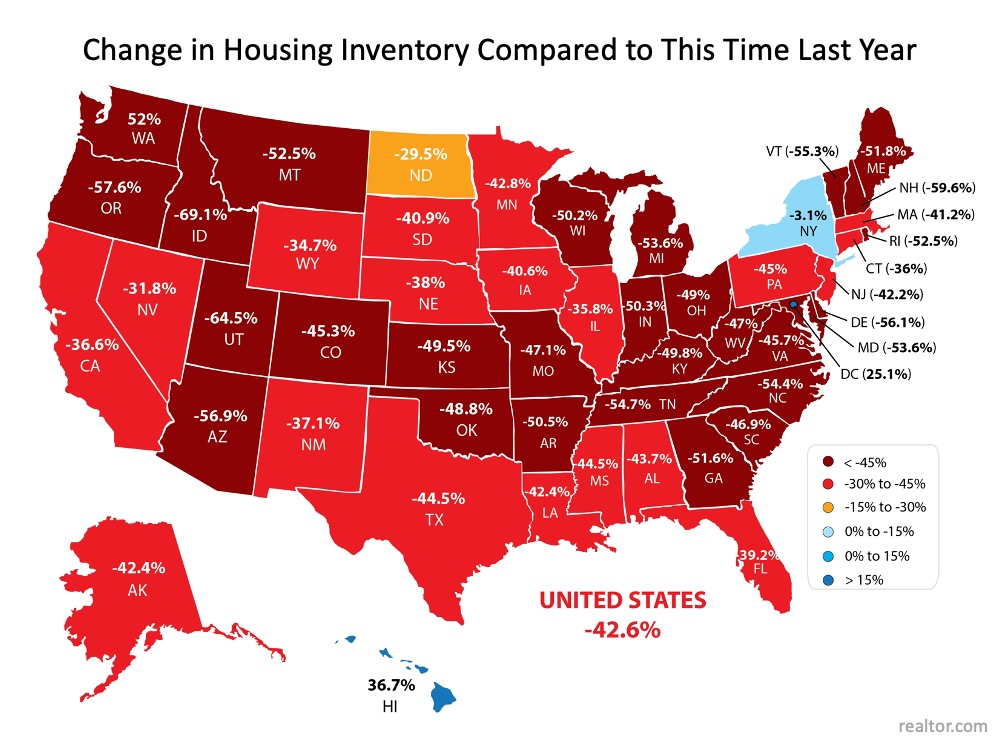
Every month, realtor.com releases new data showing the year-over-year change in inventory of existing homes for sale. As you can see in the map below, nationwide, inventory is 42.6% lower than it was at this time last year:

Does this mean houses aren’t being put on the market for sale?

Not exactly. While there are fewer existing homes being listed right now, many homes are simply selling faster than they’re being counted as current inventory. The market is that competitive! It’s like when everyone was trying to find toilet paper to buy last spring and it was flying off the shelves faster than it could be stocked in the stores. That’s what’s happening in the housing market: homes are being listed for sale, but not at a rate that can keep up with heavy demand from competitive buyers.

In the same realtor.com report, Hale explains:

“Time on the market was 10 days faster than last year meaning that buyers still have to make decisions quickly in order to be successful. Today’s buyers have many tools to help them do that, including the ability to be notified as soon as homes meeting their search criteria hit the market. By tailoring search and notifications to the homes that are a solid match, buyers can act quickly and compete successfully in this faster-paced housing market.”

The Good News for Homeowners

The health crisis has been a major reason why potential sellers have held off this long, but as vaccines become more widely available, homeowners will start making their moves. Ali Wolf, Chief Economist at Zonda, confirms:

“Some people will feel comfortable listing their home during the first half of 2021. Others will want to wait until the vaccines are widely distributed.”

With more homeowners getting ready to sell later this year, putting your house on the market sooner rather than later is the best way to make sure your listing shines brighter than the rest.

When you’re ready to sell your house, you’ll likely want it to sell as quickly as possible, for the best price, and with little to no hassle. If you’re looking for these selling conditions, you’ll find them in today’s market. When demand is high and inventory is low, sellers have the ability to create optimal terms and timelines for the sale, making now an exceptional time to move.

Bottom Line

Today’s housing market is a big win for sellers, but these conditions won’t last forever. If you’re in a position to sell your house now, you may not want to wait for your neighbors to do the same. Let’s connect to discuss how to sell your house safely so you’re able to benefit from today’s high demand and low inventory.

Posted in Housing Market
Feb. 18, 2021

Madison County January 2021 Monthly Real Estate Update

In this video Amanda Marcum, Broker/Owner of the #MARCUMsold Team at Berkshire Hathaway HomeServices Foster Realtors, discusses the current trends and numbers for the local housing market. She details how January 2021 compares to January 2020.  If you'd like to connect with Amanda directly, please call or text 859-353-2853 or Amanda@MARCUMsold.com Monthly Market Update Madison County Kentucky January 2021 January New Listings: 109 vs. 2020 January New Listings: 154 (-29%) 2021 January Sales: 96 vs. 2020 January Sales: 91 (+5%) Average Sales Price: $228,482 (+14%) Median Sales Price: $212,700 (+16%) 2021 January Average Days on the Market: 19 vs 2020 January Ave DOM: 66 (-71%) Total Number of Pendings by Month (January): 2021: 92 2020: 124 2019: 127 *Important above was provided by the Lexington Bluegrass Association of Realtors MLS.

If you’re thinking about selling your home, it's important to have a good understanding of what’s going on in the Madison County market.

Knowing the most important data such as the average sales price, number of homes sold, and days on market will better prepare you to sell your home.

Our market report showcases everything you need to know about local real estate trends.

Posted in Housing Market
Feb. 9, 2021

What is going on with this crazy real estate market?

Lets' dig into what in the world is going on with our local real estate market. So, what is happening in the market and why? Well our largest group of home buyers are millennials and they are grabbing up all the homes under $250k as fast as they come on the market. Our sellers are generally first time home sellers. Selling their first home and taking advantage of the sellers market, low interest rates and the equity they have in their home and moving up. I have some creative ways to bridge that gap buying and selling so you don't become un-homed. What we need is more homes to sell!  If you have had any thoughts of selling, I would love to speak with you!

Posted in Housing Market
Feb. 8, 2021

Unique Ideas for Celebrating Valentine's Day at Home

If last year has taught us anything, it is to appreciate all the little moments and to hold your loved ones a little tighter when you can.

That’s why we want to encourage you to celebrate Valentine's day, even if it feels a little different this year. 

Love can manifest itself in many different ways, and regardless of how it does, it deserves to be celebrated!  Here are ideas for how to celebrate self-love, family love, or romantic love - all from the comfort and safety of your home. 

Love is in the air, self-love that is! 

Never underestimate the power and value in nurturing the relationship that you have with yourself. Self-love nourishes confidence, joy, and success within you. With it comes the great power to breathe light into every corner of your life. Try one of the following suggestions below, and if you say it doesn’t lift your mood just a little, we don’t believe you!

Pamper yourself with wellness treatments

An at-home facial, herbal bath, or a manicure while listening to your favorite Spotify playlist or wellness podcasts. Treatments that soothe the body and soul will instantly uplift you.

Pick up your favorite blooms

Fresh flowers have an immediate impact on happiness, invoking long-term positive effects. Create a space for yourself that lights you up and fills you up. Fresh flowers, soft music, or an organized home base can help create a peaceful and relaxing living area.

Surround yourself with people who lift you up

Spend time with those who elevate your mindset and inspire you. This month, invite someone whose energy you enjoy to join you at home for an online yoga class, YouTube meditation session, online cooking class, or any other activity you enjoy doing with friends.

Celebrate Family Love 

The family unit has been brought closer together now more than ever. Conspire with the kids and brainstorm sweet ideas on how to make each other feel special.

Family style heart inspired brunch

This year Valentine's Day falls on a Sunday, which presents all the more reason to make a special brunch.  Pinterest search Valentine's Day Brunch Ideas for all the inspiration you will need and more!

Karaoke Night

This will guarantee family fun! Bring the snacks, prepare the singing machine, get a playlist together and have some fun. Amazon will have a portable karaoke microphone at your doorstep right in time for Valentine's Day.

Create a fun craft together

Grab the crafting supplies and make each other hand-made Valentine's Day cards or Valentine's Day themed science experiments together.

Cuddle up and watch a movie

Nothing says love like a good cuddle. Ensure the whole family feels the love by letting everyone vote on the feature film for the night. Here is a list of 23 Valentine's Day movies by Lifehack to help you get started.

Want to show your home some love too?

Take a look at our 10-Day Declutter Challenge.

Celebrate Romantic Love 

Here are a few unique ways to turn your home into a romantic sanctuary and celebrate your love.

Virtual Mixology Class together

Craft your own cocktails with some help from the Virtual Mixology course from Masterclass.com. Cheers to a fun and unique date idea.  They will teach you the essentials of cocktail making, from developing your palate to building your home bar. Learn how to mix a perfectly balanced drink for every occasion and mood—and become your friends’ new favorite bartender.

Make a vision board together and plan future trips

Make a collaborative travel vision board and map out the places you would love to visit together. You will be surprised at how fun the process can be of letting your adventurous spirit think of all the travel possibilities once we can dust our passports and get some new stamps. 

Surprise your partner with a romantic indoor or outdoor picnic

Recreate your favorite date so far. Cook the same meals you ordered, recreate the setting and the lighting and add that special touch. Don’t forget to dress up for each other and reminisce!

Create a scavenger hunt 

Keep your relationship exciting by creating a scavenger hunt for each other. You can write clues and place them around the home, leading to a sweet surprise at the end. Here are some great ideas from Pinterest.

Posted in Buying a Home
Jan. 25, 2021

What Do You Do When You Can’t Find a New Home?

Being in-between homes is more common than you think — and we have a plan if it happens to you.

At first, it sounds like a problem any seller would love: Your home sold after only days on the market. After all, the fear of a property lingering on the market, enduring possible price cuts, or low ball offers is what keeps many from selling in the first place. While a quick sale is a reason to celebrate, the challenge comes when it happens before you can find a new home. 

This is an increasingly common situation in our current market, which remains hot due to the continued limited inventory that started in April 2020. Though inventory may increase in the spring selling season, there’s a conundrum. For every home listed, another home has to be bought. Until inventory outpaces demand, securing your next home might likely take a little longer than anticipated.

Still, the upsides of a speedy home sale outweigh the inconvenience of possibly being in-between homes: Less drama, achieving your asking price (or more), and being able to consider multiple offers to find the best buyer for your house. We can help you plan ahead by following these strategies before you list.

Ask about a contingency clause.

A home sale contingency is a clause in your contract that essentially states that you won’t finalize your home's sale until you find a new home. Ordinarily, buyers find such clauses to be off-putting because it creates a lot of uncertainty in their own timelines. However, when demand is very strong like it is now, there may be a buyer out there who has a more flexible timeline for their move. (For instance, a family in the market for a home but doesn’t want to move until the new school year starts). We'll discuss it together to see if a clause would make sense for you.

Consider a bridge loan.

One of the reasons sellers panic about being in-between homes is dipping into their savings to cover the unanticipated living expenses, especially as the sale is pending on their current place. A bridge loan is a short-term loan that can cover you in this instance. (It can also add to your home purchasing power, in case that opens up more options to consider buying.) The downside is that these loans often have higher interest rates and quicker repayment periods. Do the math and read the fine print to see if this makes sense for your situation. Need some advice? Let's connect.

Look for a “vacation” rental or corporate housing.

Whether you’re located by the beach, the city, the mountains, or a quaint small town that’s popular with tourists, there are seasonal rentals to be found. While the seasonal vacation rental market is projected to pick up as travel rebounds following all that 2020 brought, these rentals weren’t going as quickly as annual rentals. In other words, there are more options to be found, often at prices lower than they’d traditionally go for. Look out for deals for off-peak rentals especially. Another option is corporate housing since they typically offer more flexibility as you settle into your new area. Both vacation rentals and corporate housing tend to be furnished, so if your furniture is in storage until you're able to buy your new home, you'll be comfortable the whole time. 

Add rentals to your home search.

Yes, you should look at the complexes in your area to get a sense of their availability and price, just in case. We have great insight about our local market and connections to agents to specialize in rentals — and not just homes for sale. Additionally, some of our clients may be on the fence about listing their home. They may consider a rental arrangement, be former buyers who purchased multi-family homes or are former buyers who purchased vacation homes that are rented out in the off-season. Which brings us to…

Hire an agent with connections.

When it comes to securing a new home in a limited inventory market, sometimes, it comes down to having an agent who knows how to leverage their connections. As your real estate agent, I'm prepared to tap into our database of potential sellers in the areas that you're considering buying. From there, we'll have conversations with each interested seller and set appointments to preview their home for you. If we can help find potential homes to showcase to you so that we're not only helping you sell your home but ensure that you can buy a home as well, we will.

When you’re putting your home up for sale, it’s easy to let anxiety take the wheel. The fear of selling your home before lining up your next home is one of those worries that commonly come up when the market is hot. However, it’s also one with a few easy solutions — and depending on your unique situation, we may have even more creative ideas depending on your market. You never know if such a scenario may be a blessing in disguise, too. Just think, next year at this time, you may be sitting pretty in an affordable vacation rental in a fun destination, taking your time to find your dream home.

Posted in Buying a Home
Jan. 15, 2021

10 Day Declutter Challenge

We're all spending more time inside these days...

If you’re like us the words “spring” and “cleaning” in the same sentence usually make us turn the other way, but in an effort to add some structure to our days and get ahead on spring cleaning, we've started a 10-Day Declutter Challenge! Whether you're waiting on this uncertainty to pass before listing your home for sale this spring or you just want to tidy up a bit around the house - this challenge is for you! Before you deep clean everything, you need to declutter. The less stuff you have, the less stuff you need to clean. Our 10-Day Declutter Challenge will help you slowly tackle decluttering your home to make it a little less daunting and a little more fun if you’re the type of person who likes to cross things off a to-do list every day. Happy decluttering!

Make sure to tag us on Facebook or Instagram using the hashtag #10DayDeclutterChallenge!

The Kitchen

DAY ONE

Junk Drawers & Countertops

Before diving too deep in grandma’s china we’ll start small. Everyone has at least one (or two) junk drawers in their kitchen. Clean these out first, throw away any actual “junk” and organize the rest.

DAY TWO

Pantry, Refrigerator, and Freezer

Remember those frozen pretzels you bought last year when you were craving them? They’ve probably expired or will stay in there for another year so it’s probably best to toss them. Go through your pantry, fridge and freezer to get rid of all expired and unwanted food items.

DAY THREE

Kitchen Cabinets

Now we can dive into the good stuff. If you’re the type of person who loves getting free cups at every event you go to or has way too many plates it may be time to part ways. You can donate anything you don’t need or toss anything that’s been used too much.

The Living Room

DAY FOUR

Books, Movies, and the Mail Pile

Unless you’re stuck in the ’90s or like to collect DVD’s there’s no reason to keep piles of them. You can toss them out, give them away, or put them in a box tucked away.

DAY FIVE

Toys, Games, and/or Office Supplies

If you have kids, it’s likely you have a lot of toys laying around. Go through the toys and games they’ve outgrown and set them aside to donate.

After decluttering your living room, here are some tips on how to stage if you are considering selling soon.

The Closets

DAY SIX

Clothes

If you haven’t heard of Maire Kondo yet, she has great tips on how to sort through your clothes that actually work. Check them out here.

DAY SEVEN

Shoes and Accessories

Just like with your clothes, sort through your shoes, belts, bags, hats, and anything else that may be hiding in your closet. Throw out or donate things that don’t fit or are not used anymore.

The Bathrooms

DAY EIGHT

Under the Sink

The space under your sink is probably filled with a couple of things... cleaning products, old lotions, and a few half-used bottles of shampoo. Take some time to go through which products you'll actually use and toss the ones you know you won't or those that have expired. 

DAY NINE

 Linen Closet and Medicine Cabinet 

Did you know that medicine expires? It does, so those old prescriptions and cough medicine should probably get tossed out. This would be a great time to put old towels in the garage for chores and to refold all the towels in that one perfect way. 

The Bedrooms

DAY TEN

Nightstands and Tops of Dressers

For the last day, let's clear off your nightstands and the top of your dressers and first give them a good dusting. We find that these areas are often neglected and tend to collect a lot of dust. Then, re-evaluate what you have on top of these spaces - is everything functional? Do the remote batteries need to be replaced? Can you get rid of anything here?

Posted in Home Decor