


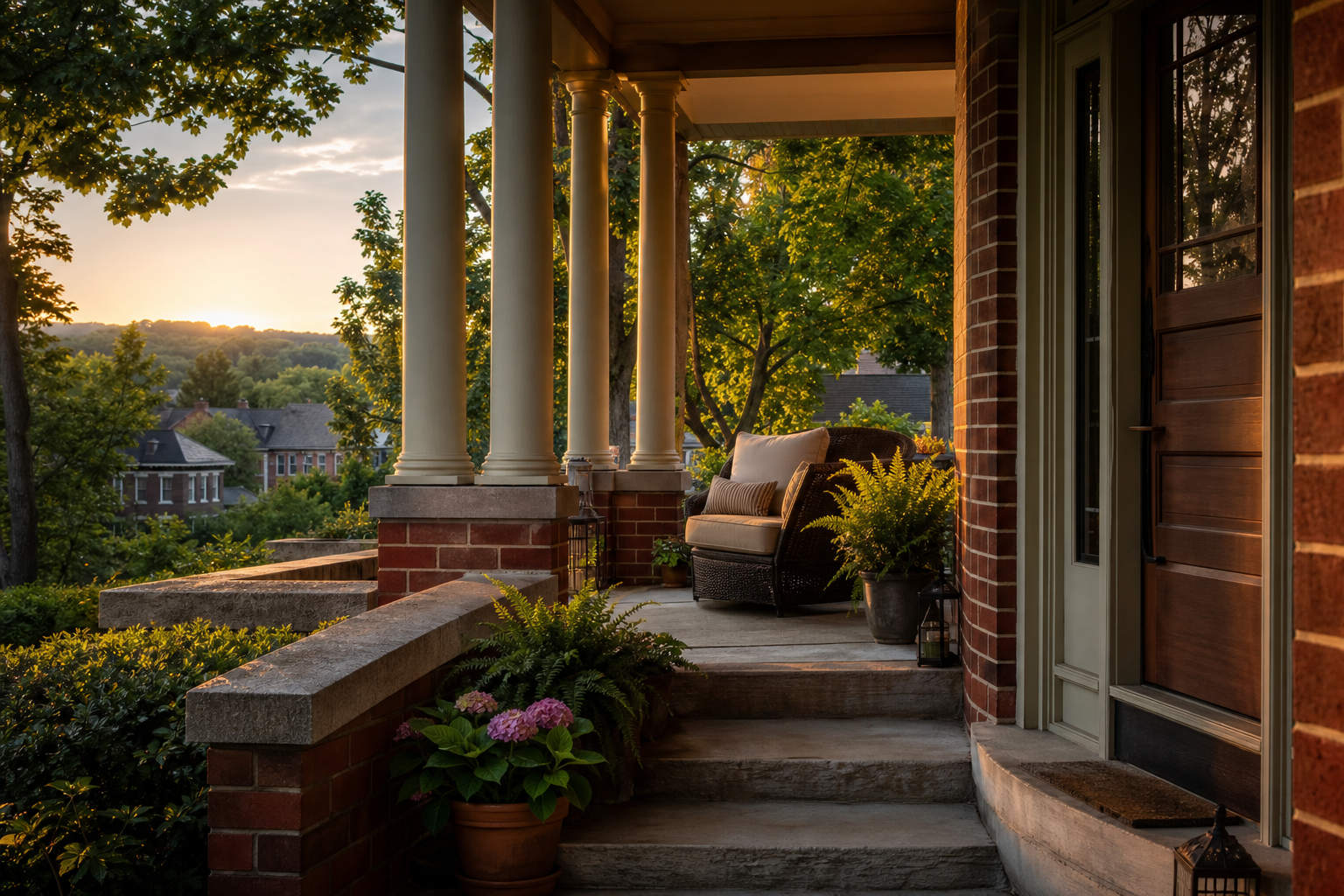
Berea College shapes Berea's housing market by housing most of its roughly 1,500 students on campus, which limits direct student competition for private rentals and keeps demand more stable. Faculty, staff, nontraditional students, and college-adjacent buyers drive consistent neighborhood activity and support steady home values near campus.
How does Berea College affect the housing market in Berea, KY?
Berea College shapes the local housing market in a way most college towns don't experience. Because the College houses the vast majority of its students in on-campus residence halls, private rental and for-sale demand near campus is driven more by faculty, staff, nontraditional students, and long-term residents than by a large pool of undergrads hunting for off-campus apartments. That structural difference makes Berea's real estate environment more stable and community-oriented than you might expect from a college town.
What Makes Berea's College-Town Market Different
Most people picture a college town and think of landlords packing in undergrads every August. Berea doesn't work that way, and understanding why matters if you're buying, selling, or investing here.
According to Berea College's own admissions profile, updated in 2026, the total student body is 1,513 students, drawn from 43 U.S. states, 3 territories, and 74 countries. That's a tightly enrolled, intentionally small institution. The U.S. Census Bureau's July 2024 estimate puts Berea's total population at 16,436, which means enrolled students represent roughly 9–10% of the city's population at any given time. That ratio alone tells you the College is a meaningful presence without dominating every housing submarket the way a large state university would.
The bigger factor is where those students actually live. Berea College's Housing and Dining page confirms fourteen residence halls of varying architecture and room configurations, plus the Ecovillage, a dedicated apartment community with 50 individual units in one- to three-bedroom configurations reserved for nontraditional students and their families. Per the College's transfer housing policy, all incoming transfer students must live on campus unless they qualify as nontraditional (age 23 or older, married, or a parent) and receive approval from the Residential Life Office.
The practical result: a large share of Berea College students are removed from the private rental market entirely. That's a meaningful structural difference from a campus where juniors and seniors routinely move off campus and compete with local residents for apartments and starter homes.
Ecovillage and Its Role in Family Housing
The Ecovillage deserves a closer look for anyone evaluating Berea's family rental market. Those 50 college-owned units absorb some of the nontraditional student households, married students, students with children, who might otherwise be renting single-family homes or duplexes in Berea's surrounding neighborhoods. In a city of this size, 50 units is a meaningful number. It likely moderates some pressure on family-sized rental stock near campus, while also clustering a portion of student families in a purpose-built community with a distinct character.
For buyers looking at rental investment near campus, that's worth knowing. The demand pool for off-campus housing skews toward faculty, staff, alumni, and long-term residents rather than a revolving door of undergrads. That tends to mean longer tenancies and a different tenant profile than you'd find at a large research university.
Who Is Actually Driving Housing Demand in Berea?
With most undergrads accounted for on campus, the private housing market in Berea draws from a few distinct groups.
College employees and affiliated households are a consistent source of demand near campus. Faculty and staff who want walkability to the College and to downtown Berea's arts district tend to look in neighborhoods within a short drive or bike ride of the 140-acre campus, per U.S. News's Berea College profile. These buyers often prioritize character, proximity to cultural amenities, and long-term stability over square footage.
Long-term Berea residents and regional buyers make up the broader market. Berea sits along I-75 and draws buyers who commute to Richmond, Lexington, and other Central Kentucky employment centers. For those buyers, the College's presence is a community amenity rather than a direct housing driver.
Relocation buyers are increasingly part of the picture. Berea's arts identity, lower cost of entry compared to Lexington, and the cultural activity generated by the College make it attractive to buyers arriving from outside the region. We work with relocation clients regularly, and Berea comes up as an option more often than it used to.
What the Market Numbers Show
Portal-level data gives us some useful trend color, though it should be read as directional rather than authoritative. The most recent report from Rocket Homes shows a median sold price of $265,000 in Berea as of June 2025, up approximately 3% year-over-year at that point. Separately, RealtyTrac's Madison County trend data shows a county-wide median sold price of roughly $247,200 as of May 2025, up from $246,400 in June 2024. A Realtor.com snapshot from early 2026 pegged Berea's median listing price at around $277,200, with approximately 144–150 active listings citywide at that point.
| Data Point | Figure | Period | Source |
|---|---|---|---|
| Berea median sold price | $265,000 | June 2025 | Rocket Homes (portal estimate) |
| Berea year-over-year price change | +3% | June 2025 | Rocket Homes (portal estimate) |
| Madison County median sold price | $247,200 | May 2025 | RealtyTrac (portal estimate) |
| Berea median listing price | ~$277,200 | Early 2026 snapshot | Realtor.com (portal estimate) |
| Berea active listings | ~144–150 | Early 2026 snapshot | Realtor.com (portal estimate) |
| Berea city population | 16,436 | July 2024 estimate | U.S. Census Bureau |
| Berea College total enrollment | 1,513 students | 2026 (most recent available) | Berea College Admissions |
All portal figures above are trend estimates, not official government or MLS data, and describe conditions at the stated snapshot date. Prices in Berea in 2026 may differ. If you want current, verified pricing for a specific property or neighborhood, that's a conversation worth having with us directly.
One pattern worth noting: portal snapshots have periodically shown Berea's median listing price slightly below the broader Madison County median. That gap fluctuates month to month, but it's consistent with what we see in our work here. Central Kentucky gives buyers more home for their money than comparable markets to the north, and Berea tends to offer solid value within that context. If you're curious what your budget gets you in this area, our post on what you can buy for $300,000 in Madison County gives you a useful frame of reference.
What This Means for Buyers and Sellers in Berea
If you're buying near campus, you're entering a market with steadier demand than the boom-bust cycle some college towns experience. The consistent enrollment at Berea College, which the College's own Fact Book shows has tracked in the 1,400–1,700 range across multiple years, creates a reliable baseline of college-adjacent activity. That stability supports resale interest, particularly for properties that appeal to faculty, staff, or buyers who value walkability to campus and downtown. You're not betting on a student rental wave that could evaporate if enrollment drops.
If you're thinking about investment property in Berea, don't assume a large pool of undergrads looking for off-campus housing. The College's on-campus requirement means that pool is genuinely small. The stronger case for Berea investment property rests on the employee base, the broader residential demand from long-term locals, and the city's growth trajectory. According to the Census Bureau, Berea grew from 15,539 residents in the 2020 Census to 16,436 by July 2024. That's real, sustained growth in a city this size.
If you're selling near campus, the College's presence is a genuine marketing asset for the right buyer. Cultural programming, the arts district, and the community life tied to Berea College attract buyers who aren't affiliated with the institution but value what it brings to the neighborhood. We've worked with sellers in these areas who were surprised by the depth of interest from out-of-area buyers who specifically sought out Berea for its character. Professional presentation matters here just as it does everywhere, and how your home shows online shapes who walks through the door.
Your specific situation depends on your property's location, condition, and what you're trying to accomplish. That's exactly the kind of question we work through with our clients before any listing goes live or any offer gets written. If you're weighing a move in or around Berea, let's talk through the numbers that actually apply to your home.
We'd love for you to read what our past clients have said about working with us on Google and Zillow.
Frequently Asked Questions
How does Berea College's on-campus housing requirement affect rental availability in Berea?
Because Berea College requires most students to live in its fourteen residence halls or Ecovillage apartments, a large share of the student population never enters the private rental market. That moderates direct student pressure on rents and vacancy rates in surrounding neighborhoods, which is notably different from larger universities where juniors and seniors routinely move off campus. Private rentals in Berea compete for a smaller student segment, primarily faculty, staff, and nontraditional students.
If most Berea College students live on campus, who is driving demand for homes and rentals in Berea?
The primary drivers are college employees, long-term Berea residents, and regional buyers who commute to Richmond, Lexington, or other Central Kentucky employment centers. Relocation buyers drawn to Berea's arts identity and lower cost of entry relative to Lexington are also an increasingly active part of the market. Student demand for private housing exists but is concentrated among a smaller group of nontraditional students who qualify to live off campus.
Does the Ecovillage reduce competition for family rentals in Berea, or increase it?
The Ecovillage's 50 college-owned units absorb some of the nontraditional student households, including married students and students with children, who might otherwise rent single-family homes or duplexes in Berea's neighborhoods. That likely moderates some pressure on family-sized rental stock near campus. The net effect is a smaller pool of student-family renters competing in the private market than you'd expect without that on-campus option.
Are home prices in Berea higher or lower than the rest of Madison County because of the college?
Portal snapshots have periodically shown Berea's median listing price slightly below the broader Madison County median, though that relationship fluctuates month to month and should not be treated as a fixed rule. The most recent available figures show a Berea median sold price around $265,000 as of June 2025 (Rocket Homes) versus a Madison County median sold price around $247,200 as of May 2025 (RealtyTrac). These are portal estimates, not official data, and conditions in 2026 may differ. A local market analysis is the only reliable way to know what a specific property is worth today.
Is Berea's housing market more stable because the College keeps enrollment around 1,500 students?
The College's consistently small, tightly managed enrollment does contribute to a more predictable demand baseline compared with markets tied to large state universities that can see sharp enrollment swings. Berea College's Fact Book shows enrollment has tracked in a relatively narrow range across multiple years. That consistency, combined with the on-campus housing requirement, means housing demand near campus is less volatile than in towns where student housing cycles dominate the rental market.
What should a buyer know about living near Berea College's campus?
Proximity to campus typically means walkability to downtown Berea's arts district, cultural programming, and community events tied to the College. Because most students live on campus, residential neighborhoods near campus don't experience the noise and turnover patterns common in off-campus student housing areas elsewhere. Demand from faculty, staff, and college-adjacent buyers tends to support steady resale interest in these areas. The tradeoff is that properties near campus may carry a slight premium for that location and community character.
The Bottom Line on Berea's College-Shaped Market
Berea College creates a real estate environment that's more stable and community-rooted than most college towns, precisely because it keeps its students on campus and manages housing internally. That means buyers get the cultural and community benefits of a college town without the volatility of a student-rental-dominated market, and sellers near campus have a genuine story to tell the right buyer.
If you're ready to explore what Berea or the broader Madison County market looks like for your situation, reach out to us for a free home valuation or buyer consultation. We've spent 18 years working this market, and we know how to connect the right property to the right buyer here.
Equal Housing Opportunity. Amanda Marcum, Principal Broker, licensed by the Kentucky Real Estate Commission. © 2024 BHH Affiliates, LLC. An independently owned and operated franchisee of BHH Affiliates, LLC. This article is general information only and is not legal, tax, or financial advice. Verify your specific numbers with your attorney, tax advisor, lender, or closing officer.